
This course introduces key surface engineering technologies used to improve wear resistance, corrosion protection, hardness, and component performance.
As industries seek to improve component performance, extend equipment life, and reduce maintenance costs, surface engineering has become an increasingly important tool. Rather than replacing entire components when wear, corrosion, erosion, or high-temperature degradation occurs, companies can modify or protect the surface to achieve the required performance while preserving the original component. Surface technologies therefore play a key role in asset life extension, reliability improvement, and sustainable industrial practices.
In this course you will explore a wide range of technologies designed to enhance surface properties through treatments such as quenching and tempering, nitriding, case hardening, welding, laser cladding, thermal spraying, PVD, CVD, and other coating processes. Selecting the most appropriate surface technology requires an understanding of the component’s operating conditions, performance requirements, dimensional constraints, and service environment. Different technologies offer different advantages, limitations, coating thicknesses, and property enhancements, making technology selection a critical part of solving industrial challenges.
Understanding the capabilities and limitations of different surface technologies can help engineers and maintenance professionals select effective solutions for component repair, life extension, and performance enhancement in remanufacturing applications.
Learn through recorded video lessons, reflection activities, quizzes, and scenario-based case studies designed to help you apply concepts in practical contexts.

Type
Status
Language
Format
Duration
Price
This course is part of the Horizon Europe project R3-MYDAS, which supports the adoption of advanced remanufacturing technologies and promotes sustainable industrial practices through knowledge sharing, skills development, and innovation.
Throughout this course, you will explore:

Jaume Nin
Jaume Nin is Head of the Technical Research Department, Development and Technological Innovation at TMCOMAS.
TMCOMAS is a specialized engineering company with extensive expertise in the repair, refurbishment, and remanufacturing of rotating machinery and industrial components. Over the years, the company has developed significant capabilities in laser cladding, applying this technology to restore dimensions, improve wear resistance, and extend the operational life of high-value assets across a wide range of industrial sectors.
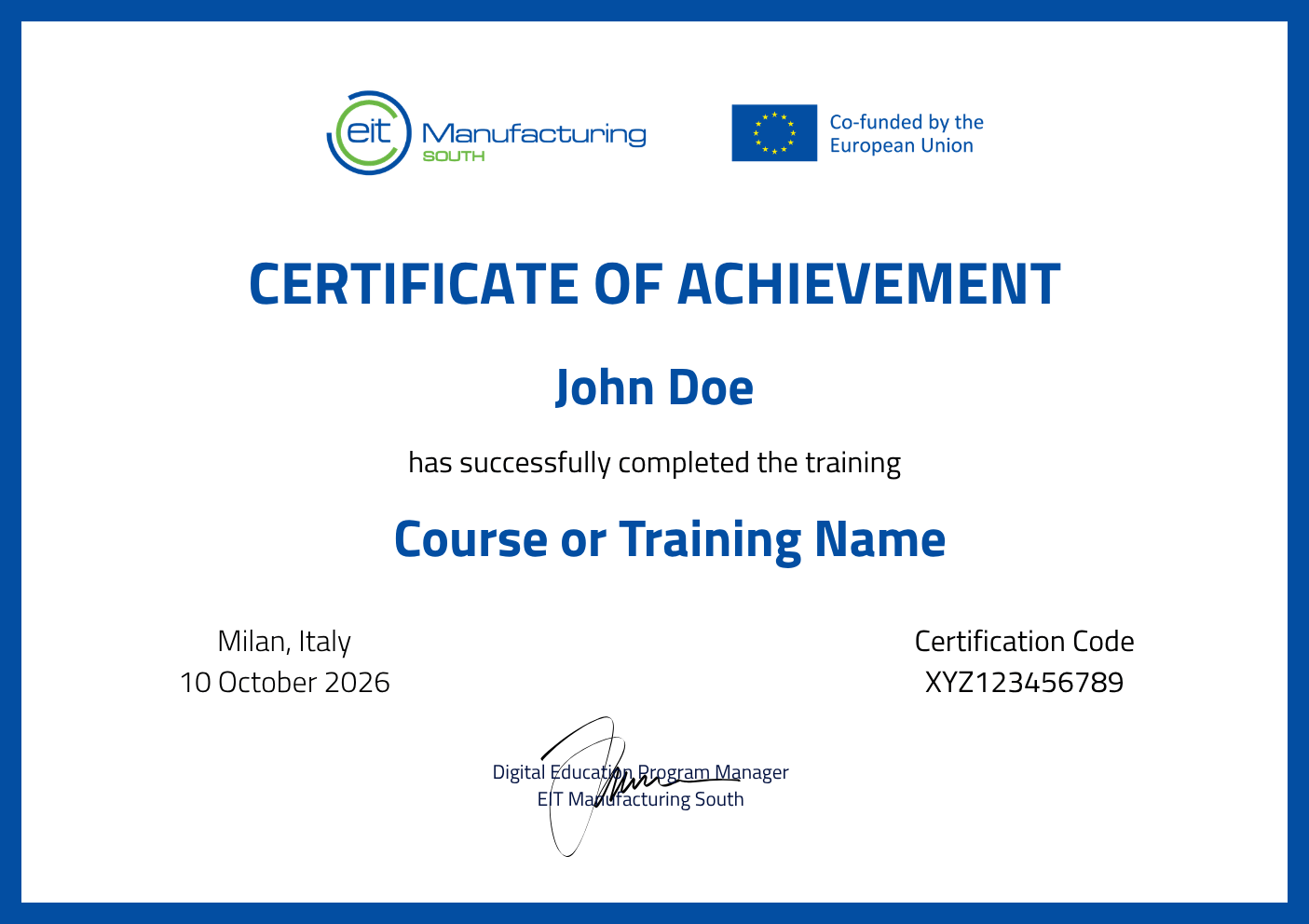
At the end of the course, you'll receive a certificate of participation from EIT Manufacturing South, recognising the skills and training you've completed. A valuable addition to your CV and LinkedIn profile.
For companies, it also serves as proof of your team's training investment and is useful for internal development plans and reporting requirements.

EIT Manufacturing South S.r.l.
Bastioni di Porta Nuova, 21 - 20121 Milan, Italy
VAT & Fiscal Code 11214340967
Register for our newsletter